Did You Know That | Week 39 | 2026


Did You Know That | Week 39 | 2026
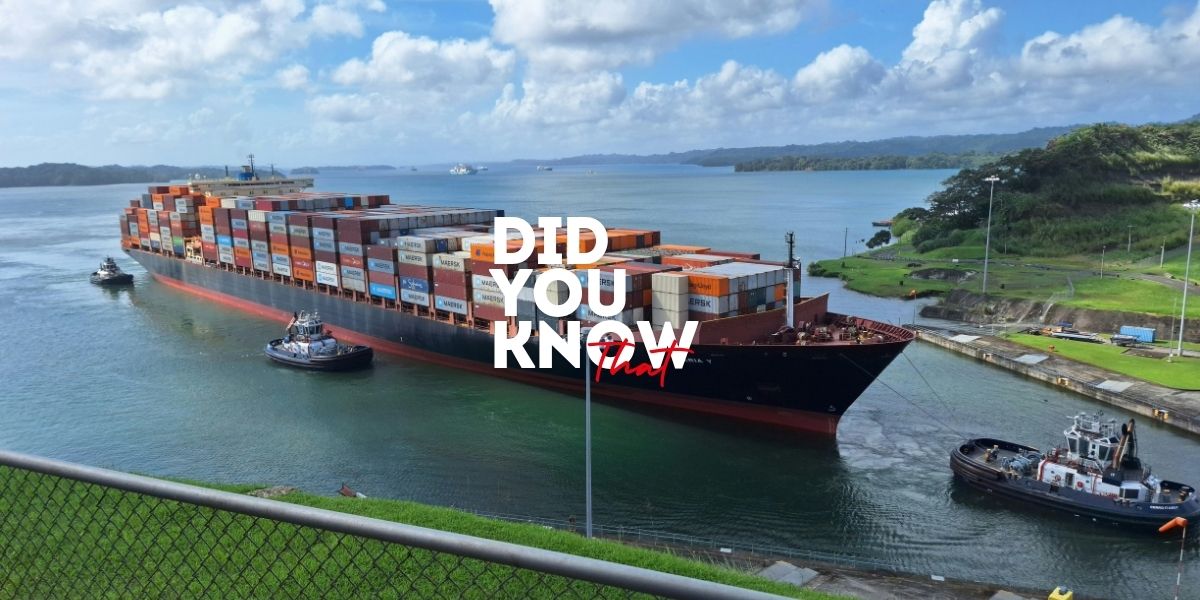
The bottleneck in container shipping has moved from sea to shore: Maersk says congested terminals and inland links, not vessel capacity, now dictate what volume supply chains can absorb.
Did You Know That…
…Landside bottlenecks, not ships, are the real constraint says Maersk, as Red Sea return gathers pace.
- Maersk will keep adding Red Sea services as long as security holds, even as Saudi-Houthi fighting intensifies — although Hormuz remains off limits
- Asia-Pacific Ocean head Bhavan Vempati dismisses rate collapse fears from returning capacity, arguing the industry’s real constraint has shifted to terminal congestion
- Danish giant’s 26-ship ULCS order is fleet renewal, not a defensive move, he says, with Asia growth a key priority.
The bottleneck in container shipping has moved from sea to shore: Maersk says congested terminals and inland links, not vessel capacity, now dictate what volume supply chains can absorb.
…Our friend Steven Yuan from FS China provided another update on the market situation.
CIF Rates and Load Factors. CIF freight rates continued to trend downward, with the pre-holiday decline deepening. The average rate is approximately USD3,000 per 40HQ. In terms of load factors, following the start of Europe’s summer holiday season, overseas booking demand weakened and carriers’ overall loading performance softened. Earlier port congestion had structurally strengthened carriers’ loading at East China ports; however, as congestion gradually eased, the loading shortfall became increasingly evident. As the Mid-Autumn Festival and National Day holiday period approaches in late September/early October, carriers face additional loading pressure from an inevitable decline in China’s export volumes. Most carriers failed to achieve full loads before the holiday, and further rate cuts are expected next week.
Resumption of Suez Canal Transits
The scope of Suez Canal transit resumption expanded further this week, and rising Middle East tensions have not yet deterred carriers from expanding Suez transits. Effective September 15, COSCO/OOCL also began restoring Red Sea transits in batches on selected Europe–Mediterranean services, including the eastbound resumption of AEU1/LL1, AEU3/LL2/FAL2, and AEU7/LL3/FAL7 on the Europe route. Under the Gemini cooperation, Maersk and Hapag-Lloyd expanded two-way transit services to six, adding NE4/AE5, SE2/AE11, SE1/AE12, and IEX/ME2; SE3/AE15 and SE4/AE19 had already transitioned in early August.
By trade lane, on the Far East–Mediterranean route: all four Gemini services have fully resumed; three of Ocean Alliance’s four services have fully resumed; MSC’s Tiger has fully resumed, while Jade is eastbound only. At present, the Premier Alliance is the only major alliance that has not yet returned. The industry’s resumption has moved from “isolated trials” to an “alliance-level expansion” phase.
Rate Increase Announcements
Maersk and CMA CGM have issued rate increase notices, planning to raise Europe route quotations to USD4,000 per 40HQ from Week 43 (October 19). This move may merely be an attempt to stem the decline through bullish rate signals; actual implementation remains to be seen after the holiday.
Additional Update
During the National Day holiday, carriers introduced extended container free-time policies to facilitate shippers’ cargo arrangements during the holiday period.
Please find below the updated rates for your reference.
…Russia, China, and Europe vie for influence as Arctic shipping surges.
- Arctic traffic hits record highs — Cargo vessel movements reached a four-year peak in August
- Russia builds, China learns — Moscow is expanding an export corridor while Beijing gains Arctic operating experience
- A strategic contest is emerging — Arctic routes are becoming a geopolitical and trade battleground.
Record Arctic vessel traffic is no longer only a shipping story. As Russia builds export infrastructure, China gains operational experience, South Korea develops maritime capabilities and Europe shifts towards security concerns, the Northern Sea Route is emerging as a strategic arena in the contest for future trade corridors.
…Mark Carney hopes to redirect Canada’s economy around Donald Trump. His Europe trip was one part of a bigger plan. CANADA IS IN a strange position. The greatest threat to its economy comes from its close ally and biggest trading partner. In 2024 exports to the United States supported 2.5m jobs in Canada and about a sixth of GDP. Donald Trump attacked as soon as he took office, prosecuting a uniquely intense trade war against his northern neighbour. In January, the Bank of Canada estimated that GDP would be 1.5% lower by the end of 2026 than had Mr Trump stayed his hand.
Mark Carney, Canada’s prime minister, has not been idle. He allowed counter-tariffs to come into effect on September 8th after rejecting an American deal that he said was not in Canada’s interest. He has recently spent more time in Europe and Asia than in the United States, drumming up investment and pushing new trade deals and alignment. And he has cut taxes at home to draw in global capital. None of this can quickly make up for the degradation of the economic relationship with the United States; Canada’s goods-and-services exports to the European Union increased by C$9.5bn ($6.8bn) in 2025, while sales to the United States declined by C$26.3bn. But in constructing credible new routes to market for Canada, he hopes to encourage investment that can buoy up the economy even as American business ebbs.
…China’s Pinglu canal is meant to carry new supply chains, not just old cargo.
- The waterway’s bigger goal is to redraw southwest China’s supply chains around Southeast Asia
- Pinglu should target Asean markets with a focus on intermediate goods and basic raw materials
- The canal’s initial success depends on cargo, feeder infrastructure and logistics services developing together.
Beijing hopes the Pinglu Canal will draw southwestern China more deeply into production networks centred on Southeast Asia.
…OTA (Overseas Transit Agency), our member in Pakistan, is extremely proud to announce that their Managing Director, Mr. Saeed Ahmed Qureshi, has been elected Vice Chairman of the Pakistan International Freight Forwarders Association (PIFFA) this year. Attached is the announcement shared by OTA. Please join me in congratulating Mr. Saeed Ahmed Qureshi on this well-deserved and honorable appointment. We wish him every success in this new role!
…China’s president Xi Jinping attended the BRICS summit in New Delhi on his first trip to India for seven years.
…India’s trade deficit narrowed unexpectedly in August, from $32bn to $27bn. Exports surged by 26% year on year, because of strong demand from America and Europe, while imports rose by 14%.
…Aliko Dangote, Africa’s richest man, listed his refinery business on Nigeria’s stock exchange in what is expected to be Africa’s biggest-ever IPO. Valued at around $49bn, the company hopes to raise $1.6bn by October.
…L’Oreal overtook LVHM to become France’s most valuable listed company, the first time since 2017 that a non-luxury firm has held the crown.
…Sam Altman of OpenAI, Elon Musk of XAI and Dario Amodei of Anthropic called for a slowdown in the race to build superhuman artificial intelligence, amid fears that models could escape human control. Meanwhile, Microsoft published a draft “Code of Conduct” designed to keep its AI models under human control.
…What having a daughter does to a boss. Male managers hire more women after becoming a “girl dad”. Women across the rich world still earn 12% less than men. Schemes designed to narrow the gap—such as quotas and diversity training—often backfire. But a paper published in the Review of Economic Studies, a journal, found something that does change how male managers perceive women in the workplace: having a daughter.
Have A Great Weekend !
…This DYKT news bulletin will be published on the website as well, go to www.eaanetwork.com.